

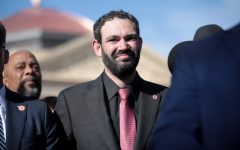
State Representative Alma Hernandez speaking with attendees on the floor of the Arizona House of Representatives on opening day of the 57th legislature in Phoenix, Arizona, January 13, 2025 (Photo: Gage Skidmore)
Hernandez, Kolodin Advance Bipartisan Court ‘Due Process’ Bill
Rare bipartisan rebuke of AZ Supreme Court process results in HB2976
By Holly Dietrich, February 9, 2026 4:04 pm
PHOENIX – House Bill 2976, a proposal to require due process protections before state or county entities materially alter the statutory administrative authority of elected justices of the peace (JP), advanced Wednesday after a contentious hearing that devolved into a separation-of-powers dispute between lawmakers and the Arizona Supreme Court’s government affairs director.
The bill, sponsored by Rep. Alma Hernandez (D-20) along with a bipartisan group of lawmakers, including Rep. Alexander Kolodin (R-3), would require written notice of the factual and statutory basis for an administrative action, an opportunity for a hearing before an independent hearing officer, and written findings under a “clear and convincing” standard, with judicial review available.
HB2976 also attempts to cabin “administrative supervision” over justice courts by specifying areas it does not include, such as operational control, personnel decisions, payroll or budget management, or directives that displace a justice of the peace’s statutory authority, unless expressly authorized by statute or necessary to fulfill constitutional supervisory duties.
Two Pima County justices of the peace testified in support, describing administrative orders that shifted local control to superior court supervision with no defined timeline for restoration, arguing that elected officials remain accountable to voters even after their operational authority is removed.
Leanna Garcia, director of government affairs for the Arizona Supreme Court, opposed the measure as unconstitutional under Article VI, Section 3, arguing the Legislature cannot dictate how the chief justice exercises administrative supervision. Garcia pointed to past problems in justice courts to justify the Court’s ability to intervene quickly, which prompted pushback from members who said her testimony disparaged elected JPs and the voters who choose them.
The hearing grew visibly tense as Garcia repeatedly struggled to give direct answers to lawmakers’ questions, prompting frustration from members on both sides of the aisle. Several exchanges devolved into sharp back-and-forth, with legislators objecting to what they characterize as dismissive and disparaging remarks about elected justices of the peace and, by extension, the voters who choose them. Members pressed Garcia on whether the Supreme Court’s administrative authority has any definable limits or due-process obligations. At the same time, the chair repeatedly intervened to redirect testimony and curb comments that lawmakers said reflected open contempt for the Legislature’s role and the statutory framework it created.
In a written comment provided after the hearing, Kolodin said Garcia’s testimony “finally achieved the impossible,” adding, “By calling the Legislature, the justice courts, and working-class voters dumb and unsophisticated, and insulting the very concept of democracy itself, the Administrative Office of the Courts’ lobbyist finally achieved the impossible! Bipartisan consensus that portions of the judicial branch have gone rogue and need adult supervision. This is not hyperbole. The Court’s lobbyist spent the hearing making faces at both the bill’s Democratic sponsor as well as the bill’s Republican co-sponsors on the committee. I have never witnessed anything like it in all my time at the Legislature.”
Kolodin continued, “At issue in the bill is whether there ought to be some sort of legal process before the people’s elected justices of the peace have their authority over county facilities revoked by the fiat order of unelected judges. The voters of Arizona know that one does not require a law degree to manage county facilities!”
He added, “However, the judicial branch’s approach to the bill has raised the further issue of whether its taxpayer-funded lobbying is crossing the line into violations of the canons of judicial conduct, which prohibit the Court from expressing an opinion on the constitutionality of a measure before it is properly presented in litigation. Separation of powers concerns are implicated as well – the judicial branch exists to say, ‘what the law is,’ not express opinions on what it should be.”
Kolodin finished, saying, “Unless the Court is confined to its proper constitutional role, it risks becoming the ‘select, patrician, highly unrepresentative’ super-legislature that justices Scalia and Brandeis warned us about. Only the Legislature, through wise command of the purse, can exercise the oversight necessary to avoid that disastrous outcome.”
Rep. Alma Hernandez also responded to a request for comment, stating, “This bill is about ensuring fairness and due process for elected Justices of the Peace in Arizona. JPs are elected officials, chosen by their communities to serve in a judicial role, and they should not be treated as mere employees of the Court. When a JP’s Court is taken away, preventing them from fully performing the duties they were elected to carry out, it undermines both the office and the voters who put them there.”
She continued, stating, “This legislation does not seek to strip the Arizona Supreme Court of any constitutional authority. It simply asks that due process be afforded to JPs, just as it is to every other elected official. It has been argued that JPs are not entitled to due process, but I firmly believe they should be. As a legislator, if I face allegations of misconduct, there is a defined process. Ethical investigations, hearings, and potential consequences governed by established rules. That same level of procedural fairness has not historically been available to JPs.”
Hernandez also added, “Justices of the Peace take their responsibilities to their communities seriously. While many are not attorneys, that was an intentional choice by the state, and they receive the judicial training necessary to competently perform their duties. Unless the state intends to change the qualifications for the office itself, that issue is irrelevant to this discussion. This bill simply ensures that elected JPs are treated with the respect, fairness, and due process their office deserves. I am going to continue fighting for them because this issue has gone on way too long in my community.”
The committee advanced the bill on a 6-1 vote, with six members voting aye and one voting present to give HB2976 a do-pass recommendation.


- Hernandez, Kolodin Advance Bipartisan Court ‘Due Process’ Bill - February 9, 2026
- ADEQ Adopts New Regulatory Fee Structure - February 5, 2026
- Gillette Anounces Hobbs-Sunshine Pay-for-Play Escalation - February 4, 2026
RELATED ARTICLES
-
 October 11, 2024
 -
 July 8, 2024
 -
February 13, 2024