
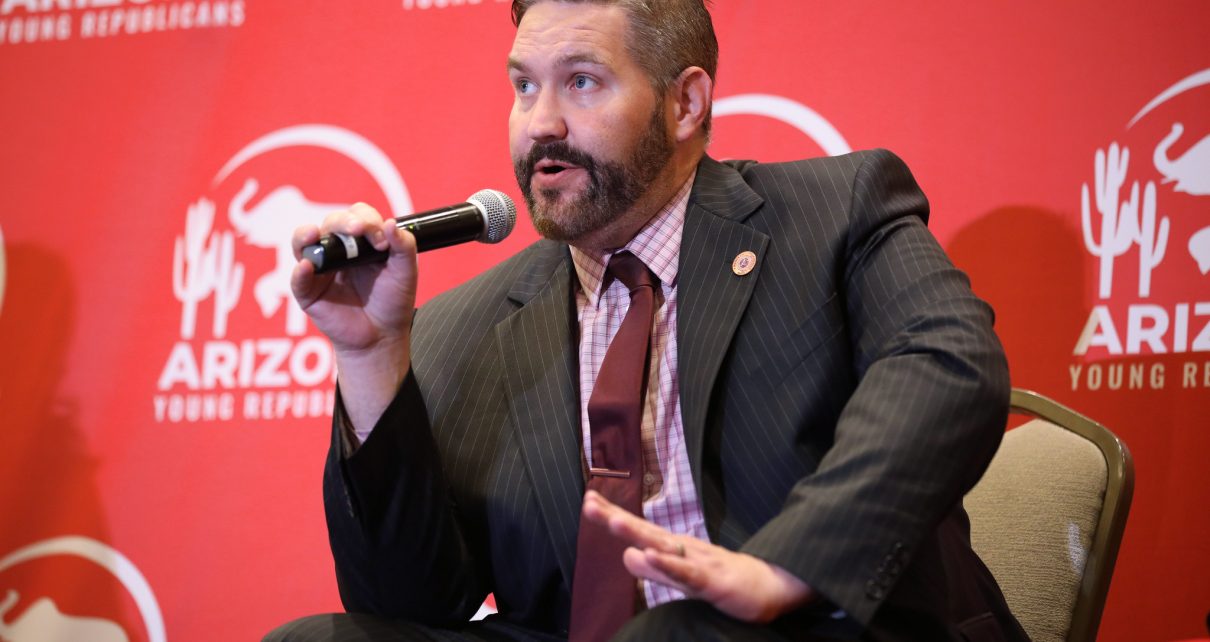
State Representative Justin Heap speaking with attendees at the 2024 Arizona Young Republicans State Convention at the Embassy Suites by Hilton Scottsdale Resort in Scottsdale, Arizona, May 4, 2024 (Photo: Gage Skidmore)
Judge Denies Maricopa BOS Reopening Discovery in Heap Dispute
States BOS failed to provide good cause to reopen discovery
By Christy Kelly, March 12, 2026 4:28 pm
PHOENIX – A Maricopa County Superior Court judge has rejected an attempt by the Maricopa County Board of Supervisors (MCBOS) to expand discovery in its ongoing legal dispute with Maricopa County Recorder Justin Heap. The Honorable Scott A. Blaney criticized the Board’s actions and warned that the court will not allow outside maneuvering to influence the case. In the March 11, 2026, ruling, Blaney denied the Board’s request for Rule 56(d) relief and an expedited hearing, finding that the Board failed to establish “good cause” for reopening discovery after the case had already moved through the briefing stage and an evidentiary hearing.
“The Court finds that Defendants have not established good cause for their requested relief,” Blaney wrote.
The dispute stems from a special action lawsuit between the Maricopa County Recorder and the Maricopa County Board of Supervisors. According to the ruling, the case has already progressed through a full evidentiary hearing in which both sides presented documents, witness testimony, and cross-examination. But the judge said the Board attempted to circumvent the court process after that hearing.
According to the denial, the Board issued the disallowed subpoenas to the Recorder and the witnesses who had testified on his behalf almost immediately after the evidentiary hearing. Rather than requiring testimony before the court, the subpoenas compelled witnesses to appear before the Board itself. The court raised serious concerns about that move.
“The Court became concerned that the Board had issued these subpoenas in retaliation for the witnesses’ testimony at this Court’s evidentiary hearing,” Blaney wrote, adding that the subpoenas appeared designed “to improperly influence these proceedings.”
The judge noted the subpoenas required witnesses to appear before a hostile party rather than a neutral arbiter, without the protections normally afforded in court proceedings. Those concerns prompted the court to issue a Temporary Restraining Order blocking enforcement of the Board’s subpoenas while the case continued.
In the latest ruling, Blaney made clear that the court would not allow the Board to use testimony obtained outside the courtroom to challenge testimony already presented under oath.
“The Court will not allow this gamesmanship to interfere with or jeopardize the integrity of these proceedings,” Blaney wrote.
The judge went further, rejecting the Board’s attempt to use Rule 56(d) as a mechanism to reopen discovery.
“This is not a proper use of Rule 56(d), asserted for the first time after the parties agreed to a briefing schedule, filed cross-motions for summary judgment, and appeared at the evidentiary hearing,” the order states.
Blaney also emphasized that the case is a special action in which discovery is not routinely permitted. Even if the Board’s request had technically qualified under the rule, the court said it would not reward the tactic.
“Even if Defendants’ request actually constituted a proper use of the rule (it does not), the Court would still not reward such shenanigans by allowing this extra-judicial ‘evidence’ to taint the record in this case,” the judge wrote.
The court ultimately denied the Board’s motion and stated that a final ruling on the merits of the dispute will be issued later. The decision represents a significant procedural defeat for the Board of Supervisors and signals that the court intends to strictly control the evidentiary record as the dispute between the Recorder’s Office and the Board moves toward final resolution.


- Judge Denies Maricopa BOS Reopening Discovery in Heap Dispute - March 12, 2026
- LD3 GOP Advances Reim, Ugenti-Rita, Khalaf for Chaplik Seat - March 11, 2026
- Kolodin Visits Goodyear’s Hoop Therapy Session - March 9, 2026
RELATED ARTICLES
-
 May 14, 2025
 -
 November 26, 2025
 -