
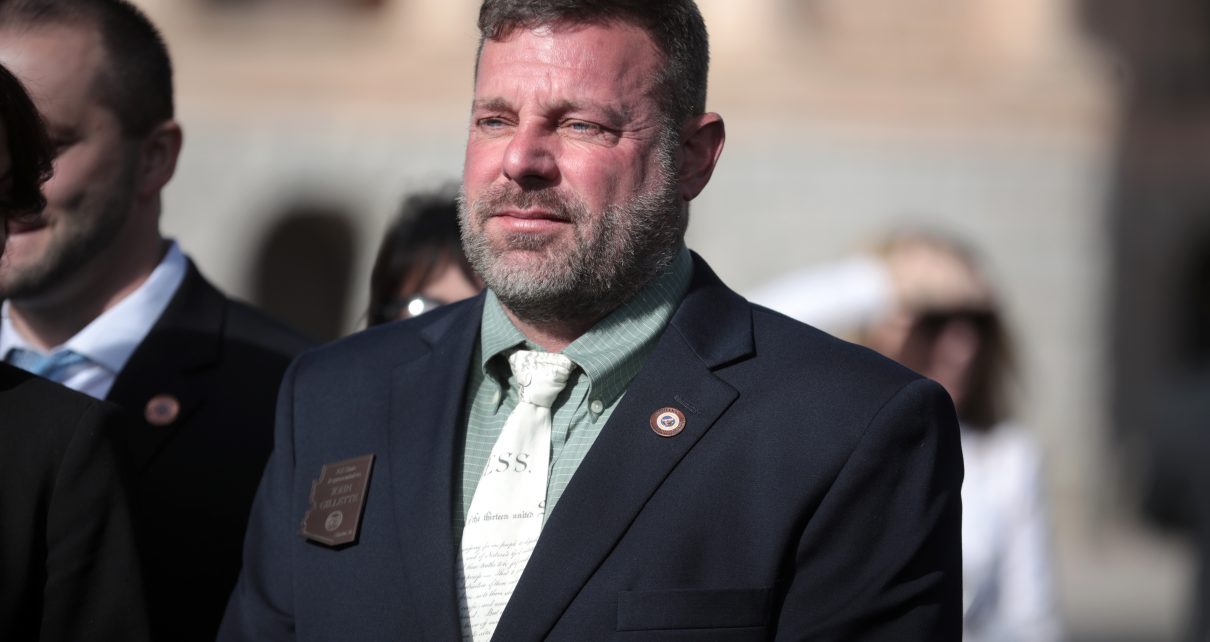
State Representative John Gillette speaks with members of the media outside the Arizona State Capitol on the opening day of the 56th Legislature in Phoenix, Arizona. (Photo: Gage Skidmore)
Gillette leads GOP Clash with Dems over DCS Structure
The sides disagree on how Dept. of Child Safety should be managed
By Holly Dietrich, February 26, 2026 7:54 am
PHOENIX – A sharply divided House hearing on Department of Child Safety reform on February 19, 2026, revealed a deeper conflict than just policy language. It revealed deep party differences on who controls the structure of child protection in Arizona – and who gets to shape the rewrite.
Rep. John Gillette (R-30) rejected claims that prior summer stakeholder meetings concluded DCS procedures were “sound.” “What I said was the laws that we passed in this body…are adequate and good to protect children,” Gillette said. “But I also said the policies, procedures, and contracts are written in a manner to circumvent the laws that we have passed.”
Gillette argued the system must be “systemically” dismantled and rebuilt into three separate entities, separating social work from criminal investigation. “We shall not have social workers adjudicating crime and investigating. That’s for law enforcement,” he said. He further alleged that congregate care placements create financial incentives, citing budget figures of “between $44,000-69,000 per child”.
Democratic members attempted to push back, not on whether DCS faces systemic failure, but on process and inclusion. Rep. Stahl Hamilton (D-21) said members were not given sufficient opportunity to shape stakeholder agendas or bring in outside experts. “It was not communicated to me that I had any option to bring outside people into the conversation,” she said. Rep. Villegas added that she received the materials late and wanted the DCS director to be present before advancing the legislation.
Chairman Walt Blackman (R-7) defended the process, stating ranking members were invited and that their own staff attended the meetings. “It is not my responsibility to do the work of your staff,” he said. He also clarified that the DCS director had been involved with the process thus far.
Gillette also directly challenged colleagues who questioned his research. “Here are the receipts that you asked for. There’s 400 pages there of contracts, rules, violations, violations of federal law,” he said, referencing a large stack of documentation he had compiled over the interim. He argued recent reports show the department in violation of its own policies, contending that the issues are not statutory gaps but administrative noncompliance. The framing shifts the debate from funding levels to enforceability and internal accountability – a distinction that could determine whether reform centers on appropriations or structural authority.
The procedural fault line may matter as much as the policy substance. The majority is framing reform as structural reorganization and the separation of enforcement. The minority is signaling concern about incomplete information, executive branch participation, and stakeholder balance before the statutory changes move.
Power implications are significant. Breaking DCS into three separate entities would redistribute the currently centralized authority, potentially expanding law enforcement jurisdiction while narrowing the internal administrative agency. Oversight would shift from executive management to legislative and, when necessary, prosecutorial review.
Whether the Legislature pursues incremental policy adjustments or a full structural overhaul will determine who ultimately controls Arizona’s child protection system moving forward.


- Gillette leads GOP Clash with Dems over DCS Structure - February 26, 2026
- Finchem, Rogers Bill to Recodify Arizona Rangers Advances - February 24, 2026
- Noem Thanks Heap, Gillette for Election Integrity Support - February 17, 2026
RELATED ARTICLES
-
 April 28, 2025
 -
June 29, 2025
-
 January 27, 2026