
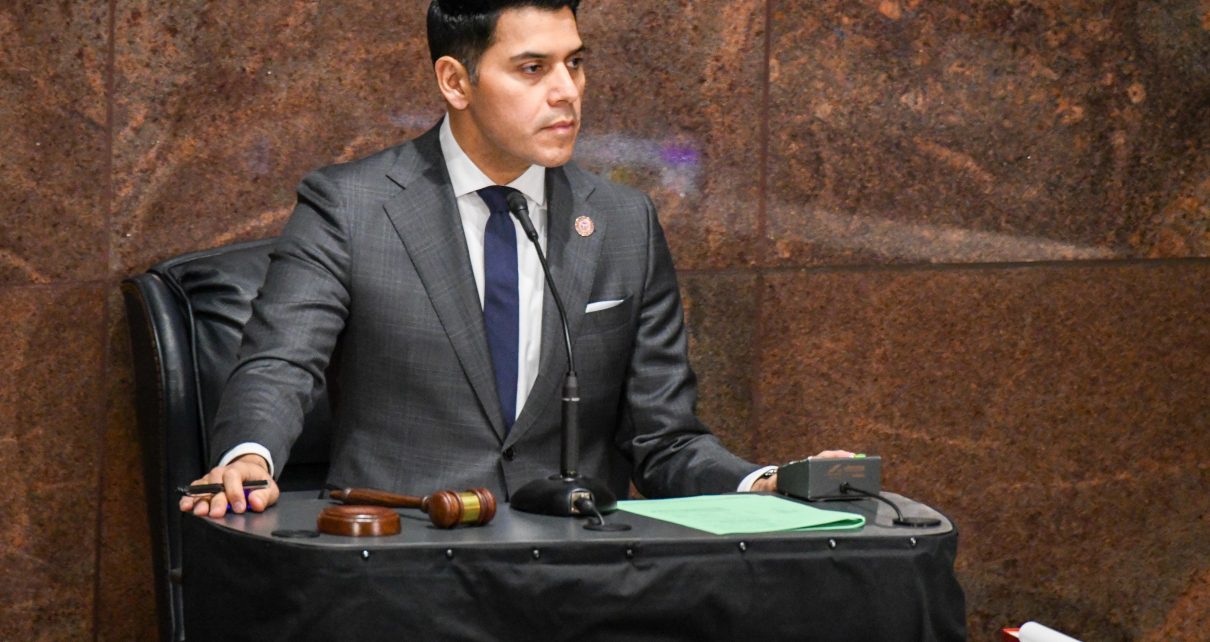
Speaker of the House Steve Montenegro March 16, 2025. (Photo: Kevin Sanders for the Arizona Globe)
Montenegro Make Hobbs’ Vetos Central to GOP Election Message
Tax conformity bill veto tops list of GOP-alleged Democrat war on Arizonans
By Steve Kirwan, March 16, 2026 3:29 pm
Gov. Katie Hobbs’ veto record has become a central line of attack for Arizona Republicans and a point of defense for state Democrats. The veto battle reflects the broader struggle of governing with a Democratic governor and a Republican-controlled Legislature. Recent fights over tax policy, particularly state adoption of tax measures included in President Donald Trump’s “Big, Beautiful Bill,” have sharpened that divide, with Republicans arguing that Hobbs’ vetoes prove that Democrats are governing in bad faith.
GOP members say that Hobbs relies too heavily on the veto pen, rejecting “common sense” legislation without offering workable alternatives. After Hobbs vetoed Senate Bill SB1106, a tax conformity bill aimed at aligning Arizona state tax laws with federal tax changes enacted January 1, 2026, House Speaker Steve Montenegro (R-29) called the move “a failure of leadership” and said it would create “unnecessary confusion and disruption for millions of Arizona taxpayers.” In a later statement backing another conformity package, Republican legislative leaders said they were moving to “end tax filing confusion” and protect taxpayers during filing season. That argument has become a broader GOP message: Hobbs is not just rejecting bills but blocking the majority’s agenda on affordability, tax policy, and government operations.
Montenegro has also tried to frame the governor’s approach as politically selective rather than policy-driven. In a January opinion release from the House, he argued Republicans had acted to return surplus money to taxpayers through conformity legislation while accusing Hobbs of doing “nothing” when lawmakers called for action. Taken together, recent Republican statements present Hobbs’ vetoes as part of a pattern of resistance rather than negotiation.
Democrats, however, argue that the vetoes reflect the bills themselves, accusing the Republican majorities of continuing to pass measures designed to score political points rather than win bipartisan support.
When Hobbs and Democratic leaders rolled out the governor’s own tax proposal in January, Senate Minority Leader Priya Sundareshan (D-18)q said the GOP alternative was “a rushed, unbalanced bill that benefits the wealthy while putting schools, healthcare, and working families at risk.”
House Minority Leader Oscar De Los Santos (D-11) called it a “reckless handout to big corporations” and praised Hobbs for rejecting it.
Their message is that the governor is not vetoing consensus policy, but stopping bills Democrats see as tilted toward the wealthy or built around partisan priorities.
Hobbs has echoed that argument in her own veto messages. In her February 12, 2026, veto letter for House Bill HB2785, the State Assembly’s attempt at passing a tax conformity bill, Hobbs wrote, “My position on tax conformity remains clear: Send me the Middle Class Tax Cuts Package.” She said she had already laid out what she would sign and accused lawmakers of advancing legislation that put “billionaires and special interests first.”
That framing gives Democrats a clear response to Republican criticism: the issue is not the use of vetoes alone, but whether the Legislature is sending bills the governor can realistically support.
The result is a familiar pattern at the Capitol. Republicans point to Hobbs’ vetoes as evidence that she is obstructing the elected majority. Democrats argue the GOP is knowingly sending bills crafted for confrontation, then using the vetoes as campaign material. With neither side showing much sign of retreat, Hobbs’ veto record has become more than a tally of rejected legislation. It is now one of the clearest symbols of Arizona’s divided government and the competing narratives each party hopes voters will carry into the next election.


- Montenegro Make Hobbs’ Vetos Central to GOP Election Message - March 16, 2026
- Finchem Bill Would End Elective Gender Changing Drugs - February 25, 2026
- Pinal’s Miller Wins Round 1 in County’s ICE Ban - February 20, 2026
RELATED ARTICLES
-
 September 2, 2024
 -
 March 19, 2025
 -
 August 25, 2025