
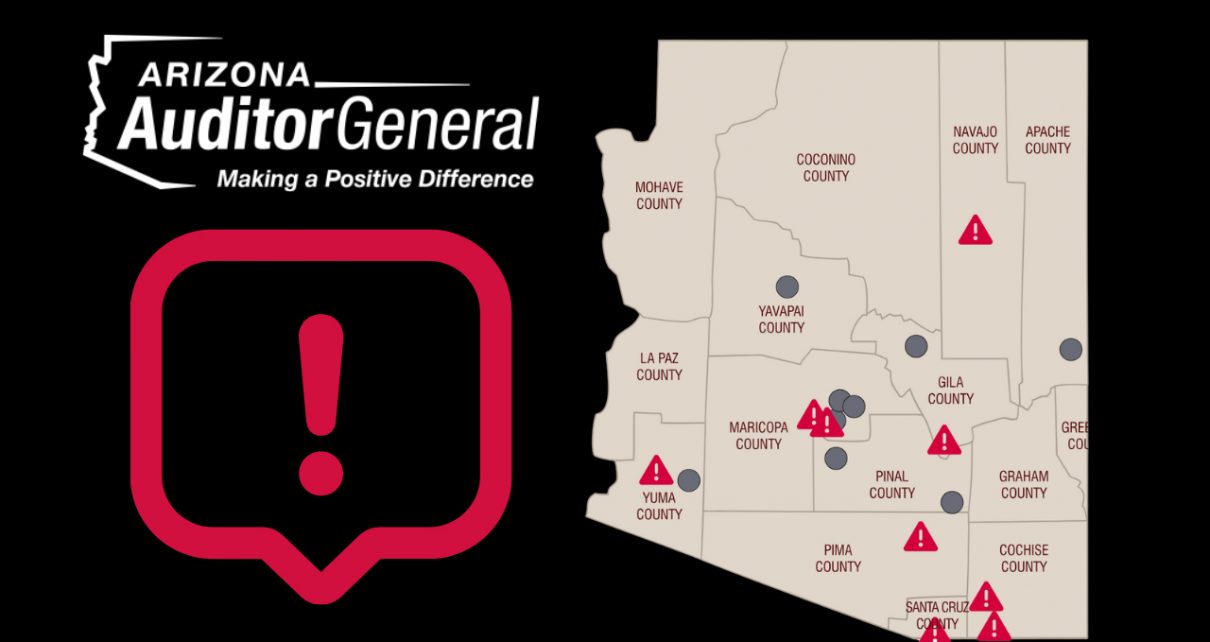
Auditor report graphic (Image by Holly Dietrich for Arizona GLobe)
AZ Audit Shows Growing Fiscal Distress in Schools
Districts with financial failures increase despite rising funding
By Holly Dietrich, January 28, 2026 2:11 pm
PHOENIX – The Arizona Auditor General has released a sobering financial risk analysis showing a sharp rise in the number of Arizona school districts drifting toward fiscal distress. The report not only pushes back on the constant drumbeat for more resources—highlighting years of increased state funding—but also raises questions about district-level management and the effectiveness of state oversight.
The January 2026 report identified nine of Arizona’s 207 school districts in the highest financial risk category, with another nine nearing that threshold. Those districts failed seven of ten financial measures. Compared with last year’s audit, the results suggest a broader statewide trend rather than a handful of isolated budgeting problems.
Auditors warned that districts facing sustained enrollment declines and shrinking reserves must take “immediate” corrective action to remain solvent. One of the most common warning indicators is a decline in weighted student count, the metric used to calculate base funding. Sixty-nine districts are currently considered high risk on that measure alone. However, the Auditor General emphasized that enrollment loss is not inherently destabilizing—provided districts adjust spending accordingly. The real danger emerges when staffing levels, administrative costs, and operating expenses remain essentially unchanged even as revenues fall.
Several of the districts facing the highest financial risk are located in urban and southern Arizona, including Tucson Unified, Santa Cruz Elementary, Isaac Elementary, and Sierra Vista Unified. These districts were flagged across multiple categories, including eroding operating reserves, negative general fund balances, and the redirection of capital dollars to cover routine operating expenses—patterns auditors associate with delayed or ineffective financial management.
The findings arrive amid continued increases in total state funding for K–12 education. Distributions from the Classroom Site Fund and other state aid programs rose again for FY 2026, legislative budget records show, even as student enrollment declined statewide. Auditor General analyses also indicate that overall district spending increased year over year, including higher per-student expenditures. And because districts retain broad discretion over how funds are allocated, increased appropriations have not been consistently applied to their intended purposes.
Auditors also noted that, of the nine highest-risk districts, eight submitted financial risk action plans outlining steps to address their conditions. One of the at-risk districts—Wilson Elementary—did not submit a plan.
The report cautioned that without timely and sustained corrective action, financial risks can persist for years under the same leadership structures, increasing probability of legislative intervention.
Taken together, the data challenges claims that district financial instability is primarily driven by funding shortfalls. Instead, the Auditor General’s analysis identifies oversight gaps and governance errors across three major areas: responding to changing enrollment, managing financial reserves, and aligning spending with long-term funding forecasts.
With more districts approaching statutory risk thresholds, the report sharpens a critical question for state officials: when warnings accumulate despite rising funding, at what point does oversight shift from monitoring to enforcement—and who is held accountable before intervention becomes unavoidable?


- Livingston Addresses AZ Leg’s Record-Setting Votes - March 7, 2026
- Willoughby/Biasiucci Fuel Bills Delayed for Supermajority Miss - March 5, 2026
- Fink-Sponsored Abuse Custody Bill Passes House 52-0 - March 4, 2026
RELATED ARTICLES
-
 February 18, 2024
 -
 November 20, 2025
 -
 August 2, 2025